

Foundations for Fatherhood:
Practitioner Resources
Most men will become fathers, whether they intend to or not.
Primary care practitioners are well placed to support boys and men in preparing for potential future fatherhood. Care can be effectively provided to boys and men by practitioners of any gender, although some boys and men may have their own preferences.
Foundations for Fatherhood: Australian Preconception Guidelines for Paternal Mental Healthcare provide evidence-informed Principles of Care and Recommendations for supporting boys’ and men's health and wellbeing across the preconception years, from adolescence through to the transition to parenthood and in between having children. They are based on growing evidence that many mental health problems experienced by fathers originate well before conception and that earlier intervention may help prevent difficulties later in life.
The guidelines focus on opportunities for practitioners to:
identify risk early
strengthen protective factors
support help-seeking and engagement with care
provide timely intervention during adolescence and young adulthood
promote health and wellbeing before the transition to parenthood
open conversations about potential future fatherhood
Importantly, they recognise that effective care for men requires more than simply extending existing approaches. Practitioners must also understand and address the barriers that prevent men from engaging with healthcare and provide care that reflects men's preferences, experiences and pathways into support
The D.A.D. Model
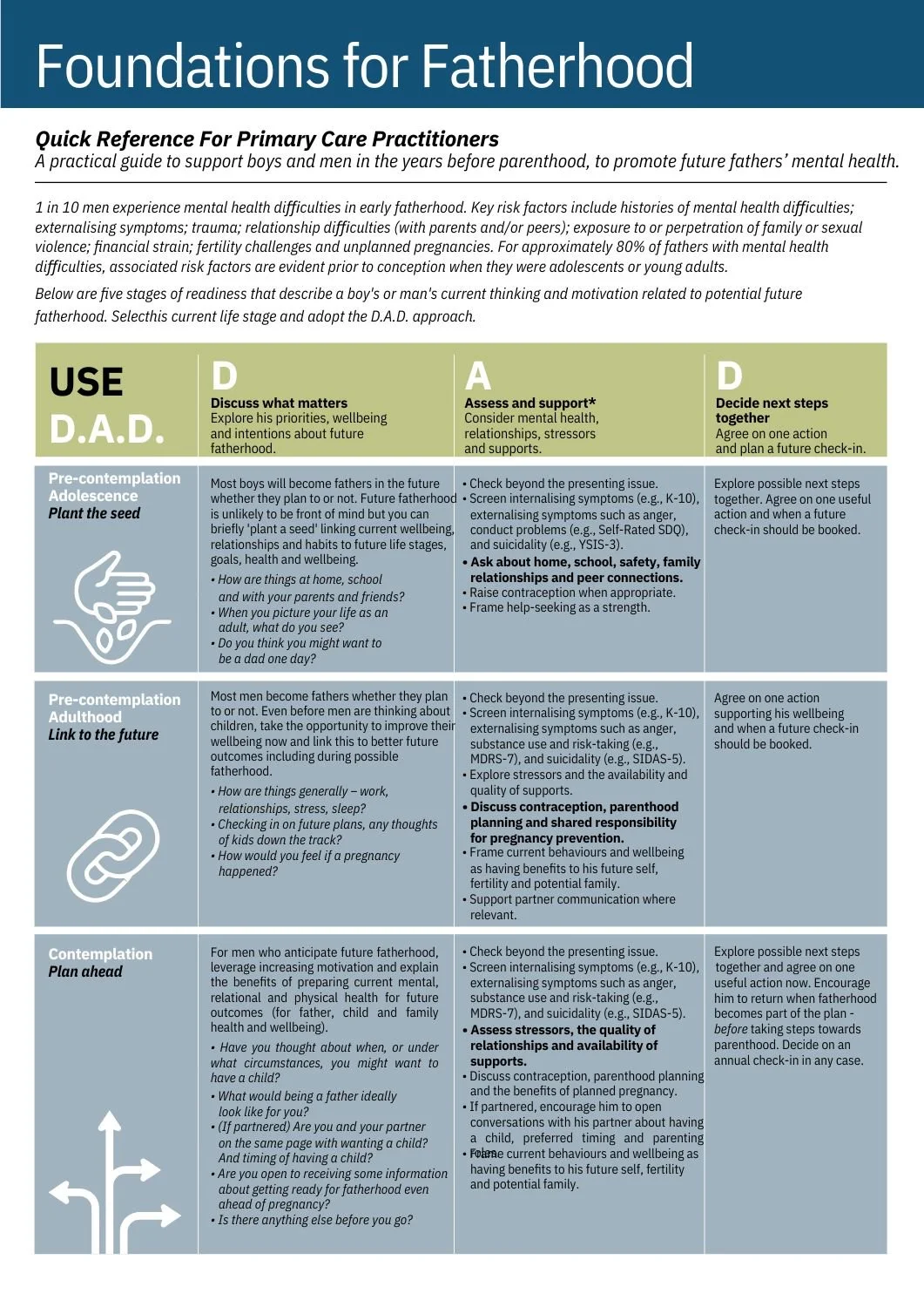
A practical guide for primary care practitioners implementing the recommendations to support boys and men in the years before parenthood, to promote future fathers’ mental health.
Use the D.A.D. Model
First, Discuss what matters
Then, Assess and support
To close, Decide on next steps together
The Quick Reference PDF outlines the D.A.D. approach aligned to the five stages of readiness that describe a boy's or man's current thinking and motivation related to future fatherhood. Simply select his current life stage and follow the recommended actions.
Download the Quick Reference for Primary Care Practitioners, and learn more about recommended screening and assessment instruments below.
Screening and assessment instruments
We know you have limited time during appointments. Here are several short screening instruments to support your assessment of boys’ and men’s mental health and wellbeing in the years before and in between having children.
Each instrument is freely available. Access the online instruments with automatic scoring or paper and pencil versions via the links below
Adolescent boys and young men
Psychological distress (includes depression & anxiety subscales) - The Kessler Psychological Distress Scale 10 (K-10)
Depression – Patient Health Questionnaire 9 (PHQ-9) Modified for Adolescents
Suicidality (age 12-25 years) - The Youth Suicide Ideation Screen (YSIS-3)
Behavioural screener (includes externalising & internalising symptom subscales) - Self-Rated Strengths and Difficulties Questionnaire (Self-Rated SDQ)
Adult men
Depression (gender specific) – Male Depression Risk Scale Short Form (MDRS-7) or Male Depression Risk Scale (MDRS-22)
Depression – Patient Health Questionnaire 9 (PHQ-9)
Psychological distress (includes depression & anxiety subscales) - The Kessler Psychological Distress Scale 10 (K-10)
Suicidality - Suicide Ideation Attributes Scale (SIDAS-5)
Loneliness – UCLA Loneliness Scale Short Form (UCLA-3)
For a list of specific instruments relating to Aboriginal and Torres Strait Islander social and emotional wellbeing, visit the AIHW website.
Support And Referral Pathways
We understand that not all practitioners can provide the breadth of care that is relevant to boy’s and mens’ preconception health and wellbeing. Referral to other specialist services forms an important part of preconception care. Care should be coordinated and ongoing.
boys and men
The Man Cave - Programs for teenage boys, educators and parents around the concept of masculinity and to build healthier relationships with themselves and those around them.
Headspace - Mental health support for young people.
Relationships Australia - State-based services available for boys, men and parents.
Preparing for a child
Prepare men who are planning fatherhood with links to services that may be helpful during pregnancy or postnatally.
SMS4Dads - Text message service with information and tips for new and expecting fathers.
PANDA - Support for parents experiencing perinatal anxiety or depression.
Red Nose - Support for parents who have experienced the loss of a baby or child.
DadBooster - Digital mental health program for new and expecting fathers.
Helplines
Mensline - Counselling service to support men with relationship issues and mental health concerns.
Beyond Blue - Telephone and online counselling service.
Lifeline - 24 hour crisis support and suicide prevention services.
1800Respect - Support for people impacted by domestic, family or sexual violence.
Kids Helpline - Counselling service for young people aged 5–25.
QLife - LGBTIQ+ peer support and referral.
13YARN - Crisis support for Aboriginal and Torres Strait Islander People.
National Debt Helpline - Financial counselling service.
Mob Strong Debt Help - Legal advice and financial counselling service for Aboriginal and Torres Strait Islander people.
National Gambling Helpline - Support for anyone affected by gambling.
Other Australian Guidelines
You may need more specific advice on managing a range of challenging presenting issues. Here is Australian guidance to support your care of boys’ and men’s mental health and wellbeing in the years before and in between having children.
mental health difficulties & externalising symptoms
Suicidality - Suicide prevention: A resource for GPs
The GPMHSC has developed this mental health first aid resource on suicide prevention to support general practitioners (GPs) in their day-to-day practice, to recognise and respond to patients whose mental health issues might be risk factors for suicide.
Anxiety - Evidence-based Clinical Practice guideline for Anxiety in Children and Young People
This is a suite of resources to help clinicians and caregivers better support children and young people with anxiety. These resources include a clinical practice guideline, quick reference resources and guides to navigate all stages of assessment, treatment and management.
Work-related mental health - Clinical guideline for the diagnosis and management of work-related mental health conditions in general practice
This guideline has been developed to provide Australian general practitioners (GPs) with the best available evidence to guide their diagnosis and management of patients with work-related mental health conditions.
Gambling - Gambling - Fact sheet for GPs
Gambling harm is complex and often occurs alongside mental health issues, misuse of alcohol and family conflict. The Factsheet provides screening and referral advice for GPs, including tailored support and other resources. It has been developed by the Victorian Responsible Gambling Foundation to help GPs dealing with patients who maybe at risk of harm from gambling.
Trauma
Trauma, PTSD and Complex PTSD - Australian Guidelines for the Prevention and Treatment of Acute Stress Disorder (ASD), Posttraumatic Stress Disorder (PTSD) and Complex PTSD
The Australian Guidelines for the Prevention and Treatment of Acute Stress Disorder (ASD), Posttraumatic Stress Disorder (PTSD) and Complex PTSD (the Guidelines) provide general and mental health practitioners, policy makers, industry, and people affected by trauma with access to recommendations reflecting current evidence on how to better respond to the needs and preferences of people living with these mental health issues.
dOMESTIC, family or sexual violence
Child sexual abuse and sexual violence
Strengthening General Practitioner responses to Child Sexual Abuse Primary Care
Strengthening General Practitioner responses to Sexual Violence Primary Care
These short foundational reference guides provide advice for GPs to help primary care recognise and respond when providing care for victims of child sexual abuse and sexual violence.
Family and interpersonal violence - Abuse and violence: Working with our patients in general practice (White Book, 5th Edition)
A comprehensive resource designed to support general practitioners and the general practice team to identify, respond to and support patients experiencing or using interpersonal abuse and violence.
Men who use violence - Identifying and responding to men who use violence in their intimate relationships
This article by RACGP describes how GPs can identify and respond to men who use violence in their relationships. It takes into account that male perpetrators are not a homogenous group, coming from all socioeconomic and cultural groups.
Reproductive health
Infertility - Australian Evidence-based Guideline for unexplained infertility
This Australian Evidence-based Guideline for unexplained infertility was generated through the ADAPTE process from the ESHRE Evidence-Based Guideline on Unexplained Infertility 2023 and is designed to provide clear information to assist clinical decision making, support optimal patient care and improve health outcomes.
Perinatal Loss
Stillbirth and neonatal death - Care Around Stillbirth and Neonatal Death Clinical Practice Guideline (CASaND Guideline)
This guideline represents a shared vision to improve care for parents and families/whānau who experience the tragedy of stillbirth or neonatal death.
Practitioner Training
Men In Mind (Movember)
Practitioners are often unsure of the best approaches for working with men. Men in Mind is an Australian online training program built for the health professionals men turn to. Evidence-informed, interactive and CPD-accredited, it gives practitioners practical tools to keep men engaged in care. Funded by the Australian Government, Movember has developed tailored Men in Mind courses for mental health professioanls, general practitioners, nurses and pharmacists. Combining Men in Mind training with an understanding of what matters for psychological health in future fatherhood, may help protect men from mental health difficulties during the profoundly important years of early fatherhood.
Tips for Talking to Teens (Black Dog Institute)
Communication challenges with teenagers are common. This webinar, part of an ongoing series on brief mental health interventions, equips healthcare professionals with the tools they need to navigate these challenges and connect with their teenage patients.
COntact Us
If you have any questions, concerns or would like to collaborate, please contact the 1 in 10 Men Project Team.
Deakin Lifespan Institute, School of Psychology, Faculty of Health, Deakin University
221 Burwood Highway, Burwood, Victoria 3125, Australia